Mammoth Lakes Flock Records

Public records brief · October 2026 · Updated Oct. 8, 2026

Mammoth Lakes Flock Cameras: What the Public Records Show

Thirty-seven findings from records released by the Town and Police Department, the school district, Mammoth Hospital, and neighboring agencies, plus documented Flock successes, each linked to the original documents and Council meeting recordings.

15
license-plate cameras on the Town's account (8 approved)
25
gunshot sensors on the school district's account
~835,000
outside-agency searches that included Town cameras
$53,000+
known public cost per year

About this brief

During 2026, local residents filed California Public Records Act requests with every agency connected to the Flock Safety cameras and gunshot sensors in Mammoth Lakes. This brief summarizes what the returned records show, so readers who haven't seen them can follow each finding, where it came from, and why it matters.

Each item covers one finding: the facts, the context, a short note on why it matters, and the specific records behind it. Statements come directly from the records unless worded as an inference (“suggests,” “consistent with,” “points to”). Search counts are our own tallies of the exported logs. Quotes from Council meetings come from the official recordings, with times given as positions in each recording.

Records referenced: Town of Mammoth Lakes / Mammoth Lakes Police Department (staff reports, contracts, invoices, billing portal, device and user lists, sharing settings, policy, network and department search logs, case reports, newsletter); Mammoth Unified School District (emails with Flock, police, and partners; renewal notice; Flock notices); Mammoth Hospital (2024–2026 emails, security committee notes, MOU drafts, signed MOU, invoice); Bishop Police Department; Kern Community College District; Mono County Sheriff. Also cited: official Town Council meeting recordings (2024–2026), an MLPD public post, and local news coverage.

Findings

Origins and approval

01

The Town Council approved a one-year, $25,000, eight-camera police program in July 2024

Updated Oct. 9, 2026: added the staff report's “entirely anonymous” statement alongside the order form's vehicle-description search. Oct. 8: added the June 5, 2024 hearing, from the meeting recording.

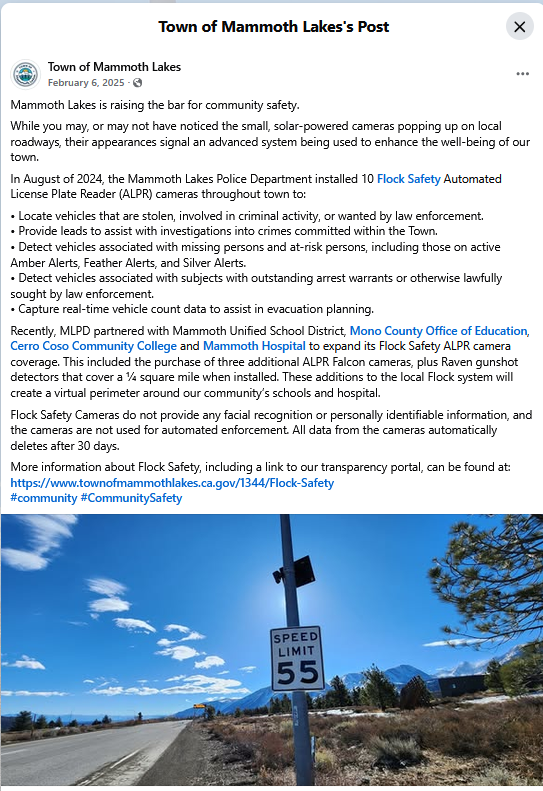
On July 17, 2024, the Council approved a one-year lease with Flock Safety, not to exceed $25,000 from the general fund, for eight fixed license-plate cameras at the Town's entry and exit points. Two of the cameras also received Flock's “Traffic Analytics,” which records vehicle state, make, and body type as well as traffic counts.

Staff told the Council that only authorized Mammoth Lakes Police Department (MLPD) personnel would have access, each with an individual login, training, and a documented reason for every search, and that use would be audited. Data would be deleted after 30 days and shared with other police agencies only for an active investigation. The presentation slides added that “MLPD owns the data,” that Flock “does not share with non-law enforcement,” and that the Council would receive an annual report. The staff report also told the Council that “the data captured by the ALPR unit itself is entirely anonymous,” while the order form in the same packet sells search by “Vehicle Fingerprint,” meaning make, model, color, and features such as bumper stickers, decals, and roof racks.

The vote followed a first hearing on June 5, 2024, which ended with the item tabled. Councilmember Chris Bubser asked “what assurances do we really have that when these data are deleted after 30 days they're gone forever.” Flock's representative answered that each image is “hard deleted” 30 days after capture and offered a follow-up with Flock's engineers. Sergeant Jason Heilman told the Council that the system lets an agency allow others to search its data, but “we are not going to do that, it's going to be shut off.” At the July 17 hearing, Town Attorney Andrew Morris said he had added contract sections 4.4 and 4.5, on deletion and reporting, in response to Council concerns, “largely” Bubser's.

Why it matters. This is the baseline: what the public and the Council were told the program would be. Every later finding is measured against it.

Sources (3)
02

The signed contract opted out of wide sharing but renewed automatically for two years

Updated Oct. 9, 2026: added the order form's network features, the renewal conflict with section 7.1, and the Truckee origin of the contract text. Oct. 8: added what the Council was told about the term, from the meeting recordings.

The Town's agreement with Flock, signed July 18, 2024, says the Town owns its data and “does not opt into the statewide or nationwide Flock network.” It requires Flock to verify deletion at least twice a year and report to the Town, and calls for a joint annual presentation to the Council. It also gives Flock a permanent right to use “anonymized” data for product development and machine-learning training.

The order form sets an initial term of 12 months and a renewal term of 24 months. It renews automatically unless either side gives notice at least 30 days before the term ends. So while the Council voted on a one-year lease, the contract itself carried the program into a two-year renewal by default.

The same signed document pulls in two directions on sharing. Section 4.1 says the Town “does not opt into the statewide or nationwide Flock network.” The attached order form lists “State Network (License Plate Lookup Only)” and “Nationwide Network (License Plate Lookup Only)” among the included features. The order form also makes renewal automatic, while section 7.1 says the Town “may exercise or not exercise” renewal “in its sole discretion.”

The contract was adapted from the Town of Truckee's. The Town's July 2024 agenda packet titled the proposal “Flock Safety x Mammoth Lakes PD (replicated Truckee),” and the Town Attorney serves both towns. The May 7, 2024 draft lists a Truckee email address for notices. Every version, including the signed one, sets venue “only in the Nevada County Superior Court” (Truckee's county; Mammoth Lakes is in Mono County), and section 7.2 refers to a “Section 17.14” that does not exist.

The term and renewal language was in the Council's July 17, 2024 agenda packet. At the June 5 hearing, Councilmember John Wentworth asked whether the Town could renew “one year at a time.” Flock's representative answered: “we can agree on any term… maybe after a year if you want to bring this back to the council and evaluate you know how effective the system has been… then you can renew for another year.” At the July 17 hearing, no one mentioned the contract term, the renewal, or the notice period before the 5–0 vote.

Why it matters. On paper, the contract described a closed, local system. In practice, continuing past year one required no new vote, only the absence of a cancellation notice. The Council had been told renewal could be decided a year at a time.

Sources (4)
03

Less than four weeks after the vote, the Police Chief asked Flock to pitch a school and hospital system

Updated Oct. 8, 2026: corrected. The Council heard in June 2024 that police were exploring a partner-funded gunshot system.

On August 12, 2024, Flock's territory sales manager emailed Chief Daniel Casabian, Mammoth Hospital's CEO Tom Parker, and Superintendent Annie Rinaldi of Mammoth Unified School District (MUSD). She wrote that “Chief Casabian asked that we put together a proposal for our Raven Audio Detection Solution that would cover Mammoth Hospital and the school campus,” along with 4 license-plate cameras “to create a virtual perimeter.”

Flock quoted Raven gunshot detection at $12,000 a year for a quarter square mile and cameras at $3,000 each per year, plus a $650 setup fee per camera. After an October 3, 2024 video meeting, the hospital's IT manager estimated the hospital's share at about $7,000 a year, “assuming that the school district also agree to pay a one third share.”

The Council had heard the idea before the vote. At the June 5, 2024 hearing, Heilman described Flock's Raven gunshot detection and said police were “currently in talks in sharing this technology with the school and the hospital.” Asked whether it was included, the Chief said it was an add-on: “that's something that I'm working with the hospital and the school district to split the cost on, but we would need to have that flock technology in place in order for them to purchase that.”

Why it matters. The second network did not start as a school-district idea. The Council heard in June 2024 that police were exploring a partner-funded gunshot system. The records show the Chief asking Flock for a proposal four weeks after the Council approved a police-only, eight-camera program.

Sources (3)
04

Flock told the partners they could run their own alerts and plate searches

Updated Oct. 9, 2026: added the hospital IT manager's October 2024 description of the system.

On October 10, 2024, Flock's sales manager wrote to the Chief, who forwarded it to the school district, County Office of Education, and hospital. Non-police partners “will have their own Flock account” with unlimited user licenses, can “create their own custom alerts,” and can “conduct a search on a license plate or vehicle description on their Falcon cameras.”

Her example: “a school principal could create an alert on a noncustodial parent's license plate and be notified when that vehicle enters school grounds.” Flock's earlier follow-up to the hospital listed alerts on “sex offenders,” “trespassers or banned people,” and “disgruntled employees.” The only things partners would lack, she said, were police alerts and access to cameras they had not paid for.

The hospital's IT manager came away with a broader picture. On October 4, 2024, he wrote that the cameras would “automatically alert PD if a previously identified vehicle belonging to a patient we either consistently have problems with, or have ‘fired’ from the hospital” entered the property, and that “it does the same with facial recognition, for the same reasons.” That was his understanding, not Flock's offer; Flock's public transparency page for the Town lists facial recognition under what the system does not detect.

Why it matters. The system was sold to schools and the hospital as a tool their own staff could use to track specific people's vehicles, not just as a gunshot alarm.

Sources (3)
05

The Chief organized the partners, but police stayed off the bill

Updated Oct. 8, 2026: added what the Council was told in 2025, from the meeting recordings.

On November 1, 2024, the hospital's IT manager told its foundation staff that “PD are specifically not getting financially involved for a myriad of reasons.” On December 10, 2024, Chief Casabian wrote: “Looks like we have four willing participants to partner in this program,” and said he would ask Flock “to keep the cost as low as possible.” He hosted the partners' planning meeting at the police department on December 20.

The four partners were MUSD, the Mono County Office of Education, Mammoth Hospital, and Cerro Coso Community College. The Chief later reviewed Raven sites on hospital property and delivered the Flock property license for signature (June 2025). The Town's February 2025 public post described it as “MLPD partnered with” the four to expand its camera coverage.

The Council was told about the plan but never voted on it. In a February 5, 2025 department report, the Chief said the four partners were “purchasing Raven” and that “it's going to be their contract with flock, they're sharing the flock information with the police department.” At the September 3, 2025 update, the Council heard that gunshot detection was active and that the school district shares its data with police under an MOU.

Why it matters. Police designed and promoted the expansion, then gained access to it, while the cost was carried by schools and a hospital district. The Town Council was told about it but never asked to approve it.

Sources (5)
06

The Town's own account grew from 8 to 15 cameras without a Council vote in the returned records

Flock's billing portal for “Mammoth Lakes CA PD,” printed September 17, 2026, lists five contracts. The original (September 2024) covers 8 cameras. A January 2025 “Expansion” adds 2 “Phase 2 Falcons” with analytics. A July 22, 2026 “Expansion” adds 5 “Falcon Flex” bundles with solar kits, on a term running to July 2029. Flock's device-health report the next day lists 10 standard cameras and 5 Flex cameras on a separate “Flex LPR” network.

The Council approved 8 cameras in July 2024. Its September 2025 item was “Presentation Only – No Action Required.” None of the returned staff reports or agenda links show Council action on the January 2025 or July 2026 expansions.

Why it matters. The Town's camera count nearly doubled after the Council's only vote. The Flex expansion came in summer 2026, as public concern was rising.

Sources (3)
07

Renewals are billed as two-year terms, and the Town said the Council approved “another year”

Updated Oct. 9, 2026: added the 2024 staff report's promise of a recommendation on whether to continue. Oct. 8: added the September 3, 2025 meeting recording.

Flock's September 15, 2025 invoice bills the original 8 cameras and analytics at $25,000, marked “Year 1 of 24 Month Term, 2025–2026.” Its January 11, 2026 invoice bills the 2 Phase 2 cameras and analytics at $7,000, also “Year 1 of 24 Month Term, 2026–2027.” The billing portal shows renewal dates of September 2027 and January 2028.

MLPD's October 2025 newsletter told readers: “The Town Council approved another year of Flock Safety ALPR cameras, giving us 10 cameras.” The September 3, 2025 staff report, however, describes a presentation with no action required. The 2024 staff report had promised that results “will be formally presented back to the Town Council at the conclusion of the year with a recommendation on whether to continue the program.” The 2025 update made no recommendation.

The meeting recording matches the staff report. The Chief introduced it as the Council's request to “return within one year” and report “how it's going.” No one mentioned renewal, cost, or contract term, and the Council took no action.

Why it matters. The public was told the Council approved the renewal. The Council's own records describe an informational presentation, while the invoices show two-year commitments.

Sources (5)
08

The first-year report to the Council covered MLPD's own searches only

Updated Oct. 8, 2026: added what the Council was told in the meeting, from the recordings.

MLPD's September 2025 “ALPR Annual Update” reported 10 cameras and 1,448 searches by MLPD from October 2024 to August 2025, including a spike of 333 during a “rash of vehicle thefts.” It highlighted six successes, including a hit-and-run, a stolen RV, and a reunited dog. It listed safeguards: “No sharing out of state,” “All searches require a reason,” and “Local sharing requires documentation.”

The slides did not mention outside agencies' searches. The network audit for the same months contains about 744,000 search records from outside organizations (see items 21–22). They also included a partnership slide with “3 additional ALPR cameras” and gunshot detection, but no costs or terms.

At the meeting, Heilman showed the Town's sharing settings and told the Council: “this network is not discoverable. Everything is disabled. We do not share out of state,” and “we do not have our network open up to where other agencies can search it.” Those statements match the settings in place by then (see item 24). At the June 2024 hearing, Mayor Bill Sauser had said he would be “very anxious at the end of that year to see… how many requests from other agencies.” The update did not give that number.

Why it matters. The Council's one scheduled check-in gave a picture of a small, local program. The returned audit data shows a much larger one.

Sources (3)
09

The public announcement was drafted with a contractor and overstated early camera numbers

Emails from January 31 to February 6, 2025 show MLPD's Christina Ackerman drafting the Town's Flock social-media post, with edits from an outside communications contractor using a personal email address. An early draft opened with “What the Flock?”, which was removed.

The published post said MLPD installed 10 cameras “in August of 2024.” The contracts show 8 cameras then, with 2 more added in January 2025. It described the partners' cameras and sensors as creating “a virtual perimeter around our community's schools and hospital,” the same phrase Flock used in its August 2024 sales pitch. It also said the cameras do not capture “personally identifiable information.”

Why it matters. Public messaging about the program was managed and promotional, and it borrowed the vendor's sales language.

Sources (2)

Ownership and control

10

There are two separate Flock accounts: the Town's and the School District's

The Town's account is “Mammoth Lakes CA PD.” MUSD has its own account, “CA – Mammoth Unified School District,” with its own deployment reports, account managers, and renewal notices. Flock's March 17, 2026 renewal notice to MUSD lists 3 license-plate cameras ($9,000) and Raven gunshot detection with “1/4mi” coverage ($12,000), for $21,000 a year, renewing automatically May 9, 2026 for 24 months.

MUSD's business officer calls it a “three-year deal” ending May 2028. In January 2025 he wrote that “MUSD mentioned being the main account holder for this service and are happy to take the lead.” In February 2026, Flock confirmed that the Raven sensors sit on a network separate from the district's cameras.

Why it matters. The expansion beyond the Town's cameras happened through the school district's account, outside any Town Council decision.

Sources (3)
11

The district's network is 25 gunshot sensors, 3 cameras, and 3 processing units

Flock's deployment tracker for the district account, dated September 17, 2026, lists 31 installed devices: 25 Raven gunshot sensors, 3 license-plate cameras, and 3 “compute boxes.” Twenty-three sensors were installed between July 23 and August 7, 2025, and two more in June 2026.

Twenty devices sit in the Town's public right-of-way. The rest are on property of the County Board of Education (3), the school district (4), the hospital district (2), and two private landowners listed as a family trust and a trustee. MLPD's July 2024 slides say one Raven device “can cover up to 1-square mile radius,” yet 25 were installed under a single quarter-square-mile subscription.

Why it matters. Most of the district's network is a grid of listening devices on Town streets and private land, not just three cameras near schools.

Sources (2)
12

Flock owns the hardware; each account holder controls its own data

Agencies subscribe to devices; they don't buy them. The property licenses signed by the County Office of Education and by Mammoth Hospital (June 13, 2025) both state that “Flock Hardware is the sole property of Flock Safety,” and the property owner can revoke permission with 30 days' notice. MLPD's report on a camera destroyed in August 2026 nonetheless describes it as “owned by the Mammoth Unified School District.”

Control of the data rests with each account holder. The Town's contract gives the Town ownership of its data. Flock told customers in December 2025 that “all Flock data is owned and controlled by the agency that collected it.” MUSD's business officer wrote in February 2026: “Since we are the contract manager, we control who gets what data.”

Why it matters. Local officials, not the vendor, decide who sees the data, what is shared, and how long it is kept. That puts accountability on the Town and the school district.

Sources (3)
13

The partners agreed to a $21,950 first-year cost split in early 2025

On January 6, 2025, MUSD's business officer sent the partners a breakdown based on their December meeting. First-year cost was $21,950: $9,000 for 3 cameras, $950 for setup, and $12,000 for Raven. MUSD, the County Office of Education, and the hospital would each pay $6,316.67. Cerro Coso would pay $3,000, toward Raven only.

On March 1, 2025, he asked for final agreement so he could “start with flock and finalize MOUs.” Cerro Coso's Kevin King replied “Yes, please proceed” on March 3, and the hospital agreed on March 11. The district's Flock subscription began in May 2025 (its renewal date is May 9), and installation followed that summer.

Why it matters. All four partners, including Cerro Coso, committed to the program in writing well before any formal agreement existed.

Sources (1)
14

The cost-sharing agreement was signed ten months after installation

Updated Oct. 9, 2026: noted the MOU's silence on search limits, retention, FERPA, and HIPAA, and the IT director's signature on Appendix A.

MUSD circulated a first draft memorandum of understanding (MOU) on June 17, 2025. Drafts from June and September 2025 named all four partners, split costs 28.78% each for MUSD, the County Office of Education, and the hospital and 13.67% for Cerro Coso, and required cyber-liability insurance. The hospital's COO signed a version in September 2025, after asking “I'm assuming no PHI?” (protected health information) and confirming the hospital's $2 million cyber coverage.

The final MOU, without Cerro Coso, was signed April 19–22, 2026 and runs from April 15, 2026 through May 2028. The cyber-insurance requirement was dropped. It makes MUSD the “primary manager and administrator” and fiscal agent. Authorized users are three County Office of Education staff and five hospital executives, with the hospital's IT director signing as authorizing agent on May 7, 2026; MUSD's own list is blank. The MOU sets no limits on hot lists, searches, or retention, and does not mention FERPA or HIPAA. The COO's question, “I'm assuming no PHI?”, has no answer in the returned records.

Why it matters. The system ran for most of a year before the partners agreed in writing who could use it and on what terms.

Sources (2)
15

MUSD paid the full first year, then billed partners over three years

MUSD “paid the full amount in FY24/25 and did not invoice due to unforeseen delays.” The MOU's Appendix B spreads that cost over the next two years. For 2025–26, MUSD invoiced the hospital and the County Office of Education $9,158.33 each: a $6,000 share plus half of the missed first-year share. For 2026–27, each is scheduled to pay $10,158.33.

The three-year total is $63,950: MUSD $25,316.68 (39.6%), the County Office of Education $19,316.66, and the hospital $19,316.66. The hospital's invoice is dated May 26, 2026, and the County Office of Education paid on June 25, 2026. The hospital's IT director told finance the cost “wasn't in the Security budget” and asked that it be added to the next year's budget.

Why it matters. These figures reconcile the partner invoices: $9,158.33 is a year's share plus catch-up for the first year.

Sources (3)
16

Police access to the district network came first, under its own short agreement

On August 19, 2025, Superintendent Rinaldi and Chief Casabian signed an MOU letting MLPD use MUSD's camera and gunshot data “solely for use in protecting public safety and responding to emergencies.” It bars sharing with immigration enforcement and “generalized surveillance unrelated to the purposes of this MOU.” It requires compliance with student-privacy law, says all access “shall be logged and subject to periodic review by MUSD,” and lets MUSD end access immediately.

It limits access to “designated MLPD personnel approved by both Parties.” MLPD sent its license-plate reader policy the same day, and sharing was being set up with Flock in early September 2025. In February 2026, MUSD's business officer proposed getting MLPD's list of “those who have our permission to pull the data.” That suggests a roster approved by both sides was not yet on file.

Why it matters. On paper, the school district holds strong oversight rights over police use of its network. The records show those rights being exercised only in 2026.

Sources (2)
17

Police use the district's networks; the paying partners do not

Flock confirmed in February 2026 that the district shared only with MLPD, and MUSD explained that police reach both the camera and gunshot networks with their police logins. On August 31, 2026, Flock again confirmed that MUSD shares “only with Mammoth Lakes Police Department” and that the hospital and County Office of Education are not listed as active accounts.

MUSD added that the hospital is “not currently interested in access.” The hospital's own security committee, meanwhile, had discussed in 2024 how to give MLPD “access to live camera feed” from its existing security cameras before setting the idea aside.

Why it matters. The organizations paying for the network don't use it. The police department, which is not billed for the district account in any returned record, does.

Sources (2)
18

Cerro Coso agreed to join, then withdrew; its replacement coverage went to the Town's Parcel

Cerro Coso's Kevin King approved the cost split in March 2025 and negotiated MOU terms with MUSD from June through September 2025. On April 7, 2026, MUSD told partners it was “official that Cerro Coso will be unable to participate,” and that “with the help from Chief we selected to have additional coverage in TOML's parcel development.” MUSD absorbed Cerro Coso's share for two years; the remaining partners split it in the third.

The district's tracker shows two gunshot sensors installed in June 2026, consistent with that relocation. On September 15, 2026, Kern Community College District stated it “is not in possession of public records responsive” to a request covering Flock agreements, although its employee's emails about the agreement appear in other agencies' returns.

Why it matters. Money raised for school and hospital safety now pays for sensors at a Town housing site chosen with the Police Chief.

Sources (3)
19

Records identify 18 license-plate cameras and 25 gunshot sensors

The Town's account has 15 license-plate cameras (10 standard, 5 Flex), and the school district's has 3, for 18 identified cameras. The district also has 25 Raven gunshot sensors. In all, the returned records identify 46 Flock devices in Mammoth Lakes, counting the district's 3 processing units.

Residents have counted about 25 Flock cameras around town. Raven sensors are also mounted on poles with solar panels, so some counted devices may be gunshot sensors. Other Flock customers, such as federal land managers, state agencies, businesses, or homeowner associations, could also operate cameras locally; no returned record from a local public agency bills for them.

Why it matters. The records now explain most of what residents see on local poles, and they show the network is much larger than the eight cameras the Council approved.

Sources (3)
20

Known public costs exceed $53,000 a year

The Town pays at least $32,000 a year: $25,000 for the original 8 cameras and analytics and $7,000 for the 2 Phase 2 cameras. The 5 Flex cameras added in July 2026 are on a separate contract whose price does not appear in the returned invoices.

The school district account costs $21,000 a year, shared with the hospital and County Office of Education under the MOU ($63,950 over three years). Known spending is therefore at least $53,000 a year, before Flex costs. Over current terms, the Town's known commitments through early 2028 total about $96,000, assuming the first Phase 2 year also cost $7,000. The district account's three-year total is $63,950.

Why it matters. Public money from four separate bodies pays for one connected system. No single board has voted on, or been shown, the full cost.

Sources (2)

How the system was used

California's license-plate reader law, and how it relates to these findings

Click to expand

California regulates license-plate reader data under SB 34 (2015), Civil Code sections 1798.90.5 to 1798.90.55. The main rules:

  • No sharing outside California public agencies. A public agency “shall not sell, share, or transfer ALPR information, except to another public agency, and only as otherwise permitted by law” (§1798.90.55(b)). “Public agency” means the state or a California city, county, or local agency (§1798.90.5(f)). In a 2023 bulletin to every California police agency, the state Attorney General wrote that this “does not permit California LEAs to share ALPR information with private entities or out-of-state or federal agencies,” and that it “applies to ALPR database(s) that LEAs access through private or public vendors” (Information Bulletin 2023-DLE-06, Oct. 27, 2023).
  • Public comment first. An agency must “provide an opportunity for public comment at a regularly scheduled public meeting of the governing body” before implementing a program (§1798.90.55(a)).
  • A written usage and privacy policy, posted online, covering purposes, authorized users and training, monitoring, sharing rules, the custodian, accuracy, and retention (§§1798.90.51, 1798.90.53).
  • An access record for every query: date and time, the plate or other data used, the user and agency, and “the purpose for accessing the information” (§1798.90.52).
  • A private right of action. A person harmed by a violation may sue for actual damages of at least $2,500, punitive damages for willful violations, and attorney's fees (§1798.90.54).

How the records in this brief relate to those rules, stated as questions rather than conclusions, because the audit logs show the scope of a search and not whether it returned a Mammoth Lakes vehicle:

  • On July 29, 2024, 377 out-of-state agencies and two federal ATF offices ran searches whose scope included the Town's cameras (item 22). Two federal Veterans Affairs police searches followed in May 2025. Flock's representative had told the Council twelve days earlier that California data “is to be shared only internally within the state by state law.”
  • For 13½ months, about 315 California agencies could search the Town's cameras through statewide sharing (item 21). Sharing with California public agencies is what the statute allows; the question is who authorized it, since the contract says the Town did not opt in.
  • The Town's Flex network is discoverable by agencies within 50 miles (item 28); Nevada is within that radius.
  • Public comment was taken on the Town's program on June 5 and July 17, 2024 (item 1). The returned records do not show a public-comment item before the school district's network was installed in 2025.
  • MLPD's policy is posted as part of its Lexipol manual on the Town website and cites §§1798.90.51 and 1798.90.53 (item 29). Flock's “Offense Type” field replaces the free-text reason in future exports (item 33); a purpose is still recorded.

This note summarizes the statute and the Attorney General's reading of it. It is not legal advice. Whether a search that included Mammoth's cameras is a “share” or “transfer” under §1798.90.55 is a legal question these records do not settle.

21

Outside agencies ran about 835,000 searches that included the Town's cameras

Updated Oct. 9, 2026: separated the one-day out-of-state searches from the 13½ months of California statewide sharing; added the contract's no-sharing clause, four more top users, and a note on NCRIC.

MLPD produced 32 monthly “network audit” exports. Flock defines this log as “searches on cameras by that agency and by users at agencies they share with.” The exports contain 839,200 rows (837,099 after removing duplicates). Of these, 834,823 came from outside organizations and 2,276 came from MLPD. The outside records fall into two groups: 2,438 from 377 out-of-state agencies in one three-hour window on July 29, 2024 (item 22), and about 832,000 from about 315 California agencies between July 29, 2024 and September 11, 2025. The January–June 2024 files are empty, and the exported files contain 2,101 exact duplicate rows, most from February 12, 2025, which are removed from these counts.

Most searches came from large California agencies, led by the Orange County Sheriff (80,316), Riverside County Sheriff (67,160), CHP (52,184), San Francisco PD (40,929), San Diego County Sheriff (27,701), Los Angeles County Sheriff (21,606), LAPD (21,431), and the NCRIC fusion center (16,749). A typical outside search spanned 500 to 990 networks at once. The logs show the Town's cameras were within each search's scope; they do not show whether a search returned a Mammoth Lakes vehicle.

The signed contract says Flock “shall not share Customer Data with any law enforcement agency or government agency other than Customer,” and that the Town “does not opt into the statewide or nationwide Flock network.” Flock treats sharing as a setting the agency controls (item 24). So either the Town authorized statewide sharing in writing, or someone with Town administrator access turned it on, or Flock shared the data contrary to the contract. The returned records do not say which.

What is NCRIC?

Click to expand

The Northern California Regional Intelligence Center is a “fusion center,” one of about 80 in a national network that the Department of Homeland Security describes as “the hub of much of the two-way intelligence and information flow between the federal government” and state and local agencies. It was established in 2007 by the board of the Northern California High Intensity Drug Trafficking Area, a federal drug-enforcement program; the two operate in partnership and share an executive director. Its 2022 annual report describes giving “15000+ vetted law enforcement partners” access to the FBI's National Data Exchange (N-DEx), escalating suspicious-activity reports to the “FBI or other federal partners,” and working “dozens of investigations in coordination with the FBI.” It serves fifteen Northern California counties; Mono County is not one of them. NCRIC's own license-plate reader policy says it “will not share, disseminate, or sell any law enforcement data to law enforcement agencies outside California, federal law enforcement,” or anyone for immigration enforcement. Its 16,749 searches that included the Town's cameras ran from July 29, 2024 to August 28, 2025; 1,787 carried a case number.

Why it matters. This is the clearest gap between promise and practice. The Council was told the system would be MLPD-only, and the contract opted out of wide sharing.

Sources (3)
22

On its first day, the network was searched nationwide, including by federal agents

Updated Oct. 9, 2026: added the Oklahoma City searches citing a CBP case. Oct. 8: clarified that the out-of-state searches were a single three-hour window.

The earliest network audit records begin July 29, 2024, eleven days after the contract opting out of the nationwide network was signed. That afternoon, for about three hours (11:22 AM to 2:18 PM), the Town's cameras were open to nationwide searches. In that window, 377 out-of-state agencies ran 2,438 searches, including police in Texas, Georgia, Ohio, Virginia, and Florida, and 14 searches came from federal ATF offices in Nashville and Louisville; 4 by Oklahoma City police cite a Customs and Border Protection case. After 2:18 PM that day, every outside search in the logs came from a California agency. The only federal searches after that were 2 by a Veterans Affairs police unit in Loma Linda, California, in May 2025.

MLPD's September 2025 report to the Council listed “No sharing out of state” as a safeguard.

At the July 17, 2024 hearing, asked about vehicles “coming down from, say, Gardnerville,” Flock's representative told the Council that “in the state of California, the LPR data is to be shared only internally within the state by state law.” The out-of-state searches began 12 days later.

Why it matters. The opt-out the Council relied on was not in effect on the system's first day. Those searches came from federal and out-of-state agencies, the very sharing MLPD told the Council it does not do. See the note on state law.

Sources (3)
23

MLPD's own officers searched statewide from the start

MLPD's department logs record its own officers' searches by name. Most covered a single network, but the maximum scope reached 462 networks in September 2024, the first month of logs, and grew to 607 by August 2025. From September 2025 on, MLPD's widest search covered 3 or 4 networks.

Searches across hundreds of networks mean MLPD was participating in Flock's statewide lookup. The arrangement was reciprocal: Flock's own settings page explains that in statewide sharing, plate data from “your cameras and searches your agency performs will be accessible to all agencies enrolled in the same network.”

Why it matters. MLPD wasn't just exposed to the wide network; it used it. Statewide participation is a two-way exchange, the opposite of the local system described to the Council.

Sources (2)
24

Outside access stopped at the end of August 2025

Updated Oct. 8, 2026: corrected. The Council was shown the closed settings on September 3, 2025.

August 2025 shows 54,074 outside records from 261 organizations, running daily through August 28. Nothing follows until 26 outside records on September 11, 2025, the last outside search in the logs. Every record from October 2025 through August 2026 belongs to MLPD.

Flock treats sharing scope as a setting each agency controls. By September 17, 2026, the Town's settings show statewide network access “Disabled” and its main network hidden from other agencies. A drop this sharp points to a deliberate settings change. It happened as the school district's network was being connected to MLPD, and three months before Flock's December 2025 warning.

On September 3, 2025, six days after the last daily outside activity, MLPD showed the Council the closed settings and described them as standing practice (see item 8). The 26 outside records on September 11 came eight days after that presentation.

Why it matters. The system's reach was narrowed without public discussion. The Council was shown the closed settings, but was not told they had recently changed or that the network had been open for the prior year. See the note on state law.

Sources (3)
25

Since then, police routinely search three networks

The July 2026 network audit has 132 records and August has 138, all from MLPD, each covering three or at most four networks. MLPD's department logs for those months show the same pattern.

The logs don't name the networks. Three matches the networks MLPD is known to reach: the Town's camera network, the district's camera network, and the district's Raven network. The Town's separate Flex network, added in July 2026, may account for the occasional fourth.

Why it matters. Routine police searches now include devices paid for by the school district and its partners.

Sources (2)
26

Police logged 2,332 named searches; about a third listed a case number

MLPD's department logs list each search with the officer's name, stated reason, case number if entered, and search type. They begin in September 2024 and record 2,332 searches by 20 people. 838 (36%) include a case number, rising to 60% in July 2026 and 69% in August 2026. Thirty-six searches give “test” as the reason.

About 65% of all entries (1,515) are “search” queries rather than direct plate “lookups”; searches can use partial plates, state, or vehicle description. Stated reasons include stolen vehicles, arson, domestic violence, hit-and-run, welfare checks, and warrants. MLPD's September 2025 slide reported 1,448 searches for October 2024 – August 2025, close to the 1,396 in these logs.

Why it matters. Every search has a reason, but most lack a case number, and most are description-based searches that can identify vehicles whose plates nobody knows.

Sources (2)
27

Twenty-four people have held logins on the Town's account, including two Sheriff's employees

Flock's user list for the Town account (September 17, 2026) shows 24 accounts: 15 active and 9 deactivated. Six active users have administrator rights, which let them manage users: the Chief, two sergeants, a corporal, an officer, and an administrative user. Thirteen active users can search.

Two active accounts use Mono County Sheriff's Office email addresses (a K9 deputy and a sergeant), with a “Dispatch” role. They have the hotlist alert tool but not search, and last logged in September 2024 and February 2025. The Sheriff's Office answered a records request by saying “we have no records regarding your request.”

Why it matters. Access extends beyond MLPD officers to county employees, and accounts stay active long after their last use.

Sources (2)
28

Current settings: the main network is closed, but the new Flex network is discoverable

As of September 17, 2026, the Town's main network has statewide access disabled and is not discoverable by other agencies. Federal share requests are disabled. Filters exclude searches for immigration enforcement and reproductive care. Flock's optional “Audit Assistance” feature is disabled. Hotlists come from California stolen-vehicle and AMBER Alert sources.

The Town's separate Flex camera network, however, is set to be “discoverable” to law-enforcement agencies within 50 miles. That lets them request access. Permissions available on request include search, alerts, live video, recorded video, and video download. None are set to approve automatically.

Why it matters. The Town has tightened its main network. Its newest cameras are open to requests from nearby agencies, including for video. See the note on state law.

Sources (1)
29

MLPD's written policy describes request-by-request sharing that the logs don't reflect

Corrected Oct. 10, 2026: the audit section’s “462.5(e)” citation is a typo for the case-number-or-reason rule, not a missing section. Oct. 9: rewrote the description of the policy after comparing the 2024 draft with the 2026 published version.

MLPD's license-plate reader policy, published March 18, 2026 as section 435 of its Lexipol manual, is the 2024 draft the Council saw, renumbered from 426; the text is otherwise unchanged. The 2024 staff report said the draft “was modeled after the City of Vallejo Police Department's ALPR policy, which was crafted with input from the ACLU.” The policy says data “may be released to other authorized and verified law enforcement officials and agencies for legitimate law enforcement purposes,” with no limit to California agencies; the “No sharing out of state” safeguard shown to the Council is not in it. Other sharing requires a written request naming the agency, the person, and the purpose, approval by the Chief or a designee, and a police report documenting the release. It requires an annual audit of at least 10 randomly selected searches, written up in a memo to the Chief, to check that each one meets the case-number-or-reason requirement. (The policy cites that requirement as “section 462.5(e),” a typo for 426.5(e) in the draft; the 2026 version renumbered the sections to 435 but kept the old citation, so it now points to 435.6(e).) It states that “reasonable suspicion or probable cause is not required before using an ALPR,” which is standard Lexipol language, and it cites Civil Code sections 1798.90.51 and 1798.90.53 (see the note on state law above).

Between August 2024 and September 2025, the network audit shows hundreds of thousands of outside searches running through automated statewide sharing. That is a different mechanism from individual written requests. The policy also says every search must carry a case number, an incident number, “and/or a reason”; reasons are present, case numbers mostly are not.

Why it matters. The safeguards in policy assume sharing happens one approved request at a time. The system as configured shared continuously.

Sources (3)
38

What outside agencies said they were searching for

Added Oct. 9, 2026.

Every search carries a reason typed by the searching officer. Among the 834,823 outside-agency searches, 74.7% of reasons are a single word and 5.4% include a case number. The most common reasons are “investigation” (42,510) and “inv” (36,332); about 840 say “test.” “LA HIDTA,” a federal drug task force (see below), appears about 12,000 times.

187 searches by 18 California agencies, between July 30, 2024 and July 1, 2025, name a federal immigration or customs agency in the reason: HSI (Homeland Security Investigations), ICE, or CBP. San Diego County Sheriff accounts for 97, including 56 marked “CP HSI” on March 4, 2025; Hermosa Beach PD 27 (“HSI Boston collateral,” “HSI red hook”); Baldwin Park PD 20 (“HSI KING”); West Covina PD 11; LAPD 10 (“smuggling and dope hsi”); CHP 1 (“ICE case”). HSI investigates drugs, fraud, and trafficking as well as immigration, so the reason text shows federal task-force use of a search that included Mammoth's cameras, not its subject. Two agencies labelled searches as protest-related: Escondido PD, “2/2/25 Protest ATI Vehicle” (7 searches, February 2, 2025), and Daly City PD, “SF PROTEST” (5 searches, June 14, 2025).

MLPD's own entries are more complete: 36% carry a case number, rising to 69% by August 2026 (item 26). MLPD's policy bars sharing “for purpose of federal immigration enforcement” and cites the California Values Act. The searches above were run by California agencies through statewide sharing, not by federal agencies directly.

What is LA HIDTA?

Click to expand

The High Intensity Drug Trafficking Areas program was created by Congress in 1988 and is administered by the White House Office of National Drug Control Policy; the DEA dedicates more than 1,500 agent positions to it nationally. The Los Angeles HIDTA, designated in 1990, covers Los Angeles, Orange, Riverside, and San Bernardino counties. Its 2026 report to Congress describes “more than 71 Federal, State, and local” agencies and over 585 personnel in “co-located and commingled” task forces. Those federally funded task forces include units led by the DEA, the FBI's Los Angeles Joint Terrorism Task Force, and two Homeland Security Investigations border-enforcement teams; its intelligence arm, the JRIC, is led by the FBI and is also the region's DHS-recognized fusion center. In the Town's logs, “LA HIDTA” was typed almost entirely by Orange County Sheriff's deputies (12,618 of the 13,167 reasons mentioning HIDTA). LAPD entered 96 searches as “LAPD GND HIDTA 52 DEA ST. LOUIS CASE LH-24-0023.” A HIDTA reason indicates a local officer assigned to a joint federal–local task force; the logs do not show whose case the search served.

Why it matters. While the Town's network was open, what it was searched for was decided by officers elsewhere, under whatever standards their agencies apply. The Town's policy governs only its own officers. See the note on state law.

Sources (2)

Data, deletion, and public pressure

30

Data leaves the live system after 30 days, but not every copy is deleted

Updated Oct. 9, 2026: added the Chief's May 19, 2026 statement that no deletion confirmations had been received, Flock's answer, the retention-schedule clause, and the litigation case name. Oct. 8: added the Council's deletion questions.

Both the Town's networks and the district account are set to 30-day retention. In August 2026, Flock told MUSD that 7 days is an option. On September 3, MUSD requested 7 days and asked how it could verify that data isn't kept longer.

Flock correspondence that Chief Casabian forwarded to Bishop PD on June 16, 2026 shows what verification existed. On May 19, 2026, the Chief wrote to Flock that language “requiring reviews or confirmations related to the deletion process was incorporated into our contract terms. However, since implementation we have not received any formal correspondence or documentation from Flock confirming the continued operation of the automated deletion process.” Flock's account manager answered that deletion “is enforced through AWS's standard S3 lifecycle policy, not a Flock-built process,” and offered a quarterly confirmation email once the cameras were reactivated (see item 39). The contract's twice-yearly reports had been due since early 2025. The policy also lets MLPD keep data past Flock's 30 days under a Town retention schedule it does not quote, and lets officers save data to case files. A July 21, 2026 Flock notice to customers says that, as a defendant in In re Flock Group Inc. Automated License Plate Reader Litigation, No. 3:26-cv-02375-VC (N.D. Cal.), Flock has “an absolute legal obligation to preserve historical and future data” potentially relevant to the case, held in storage not accessible to customers. The notice does not say whether Mammoth Lakes data is included.

The Council has asked about deletion more than once. At the June 2024 hearing, Bubser asked what assurance there was that deleted data is “gone forever,” and contract sections 4.4 and 4.5 followed. At the September 3, 2025 update, as mayor, she asked: “How do we get those assurances that it's actually being executed the way they promised?” The Chief said he would “reach out to Flock” and suggested “another quick presentation with Flock.” No such presentation appears on a Council agenda in the 2023–2026 record. On December 3, 2025, Bubser said she would keep asking “what FLOC has done to respond to us about those very specific questions we had about our data.” The contract's joint annual presentation to the Council also does not appear.

Why it matters. “Deleted after 30 days” means deleted from what officers can search. Data saved to cases, held for litigation, or kept by the vendor can last longer.

Sources (5)
31

The gunshot sensors keep audio clips of ordinary sounds

Updated Oct. 9, 2026: added the school district's “ears only” description. Oct. 8: added public statements about audio and the Town's camera policy.

After a Raven sensor on Main Street was torn down on August 18, 2026, Flock gave MLPD “the last benign recording from the device,” made at 9:16 PM, which “sounds like environmental noise.” The officer uploaded the sound file to the case as evidence. In a second case, Flock reported the time a damaged sensor switched to battery power.

Flock and MLPD described Raven as gunshot detection that “quickly alert[s] dispatch of shots fired.” The case reports show the devices also save audio of non-gunshot sounds, and that Flock can retrieve that audio for police on request.

In August 2026, The Sheet reported that, per Chief Casabian, Raven sensors “cannot record or track conversations,” and that a recording “is retained for 30 days before being automatically deleted.” The case reports above show a sensor saving a non-gunshot recording, which Flock retrieved and MLPD stored as evidence. On March 18, 2026, the Council adopted a Security Camera Policy that bars audio recording on Town cameras. When Mayor Pro Tem Brent Truax, who had asked for that line, asked how it would apply where police need audio, staff answered that the policy “only applies to non-police installations… The police department has their own policies for their cameras.”

The district describes the sensors the same way the Chief does. On February 17, 2026, MUSD's business officer wrote that the district could cut police off from camera data “but leave the gunshot detection active since it is ears only.”

Why it matters. Twenty-five of these devices sit on streets, school grounds, the hospital campus, and private land. Their recordings are not limited to gunshots.

Sources (5)
32

Four Flock devices were vandalized in two weeks, and police pursued the cases

Updated Oct. 9, 2026: added the order form's device-monitoring language.

MLPD opened four cases between August 19 and September 2, 2026. Raven sensors were destroyed or damaged on Main Street near the post office, at the pickleball complex, and at Tavern Road and Inyo Street. A district license-plate camera at Meridian Boulevard and College Parkway was removed from its pole, its cables cut. Officers collected business security video and transit-bus footage. Flock quoted $800 per device, $500 per pole, and $350 per solar panel.

Flock data showed the Meridian camera stopped working on August 8, more than three weeks before anyone reported it. Its report names the plate and vehicle of the last car the camera photographed, a passing motorist with no stated link to the case. The Town's order form says: “We proactively monitor the health of your device network.”

Why it matters. Public opposition has turned physical, and investigating it pulls ordinary drivers' data into police reports.

Sources (2)
33

Flock warned customers about public release of search logs and cut what the logs show

On December 9, 2025, Flock's senior vice president of customer experience told customers, including MUSD, that a third-party website was collecting search logs released under public-records laws. He said Flock “has not been breached or compromised” and suggested “a temporary shift from Nationwide Lookup to Statewide Lookup.”

Flock also announced that, starting around January 31, 2026, network audits would no longer show “officer name, specific plates searched, vehicle fingerprint, and open text search reason,” and added a required “Offense Type” field.

Why it matters. The vendor treats public scrutiny of search logs as a problem to manage. Future releases will contain less detail than the records this brief relies on.

Sources (1)
34

School district staff know about community concern and are pushing for tighter controls

In February 2026, MUSD asked Flock whether it could stop sharing camera data with police while keeping gunshot alerts. Its business officer proposed getting MLPD's list of authorized users and making sure officers put their names on downloads. On August 10, 2026, the district's technology chief forwarded national reporting to leadership, noting “a backlash towards the town's flock cameras” on local Facebook.

On August 27, MUSD told Flock “our community, like many others, have questions.” On September 3, it requested 7-day retention and wrote: “We do reserve the right to remove access if they are misusing this data.” Those rights already exist in its August 2025 agreement with MLPD.

Why it matters. District staff are moving toward shorter retention, named users, and revocable police access. These are staff actions; the board has not taken a formal position in the returned records.

Sources (2)
35

Neighboring agencies are distancing themselves

Bishop PD's attorneys wrote on August 31, 2026 that “Bishop Police Department cancelled the contract it had with Flock” and “no longer has access to any of the data you request.” Bishop's production shows that Mammoth's police chief had shared Mammoth's Flock deletion details with Bishop's chief in June 2026. Bishop PD also appears in Mammoth's network audit, with 29 searches between September 2024 and August 2025.

Kern Community College District says it has “no Flock access, relationship, or equipment” and no responsive records. The Mono County Sheriff's Office says it has no records and referred the request to MLPD.

Why it matters. The agencies around Mammoth are stepping back from Flock, leaving MLPD and the school district as the program's core local operators.

Sources (2)
39

The Chief described a 4–6 month “suspension” in early 2026; the logs show searches continuing

Added Oct. 9, 2026.

On May 19, 2026, Chief Casabian told Flock that information Flock had provided “satisfied the concerns that were recently raised by Council Member Bubser regarding data retention and deletion practices,” and that “we are now in the process with Flock to get the system turned back on after about a 4-6 month suspension.” Flock's reply refers to quarterly deletion reports starting once the cameras were reactivated.

MLPD's department logs show its officers' searches dropping from 93 in December 2025 to 8 in January 2026, then continuing at 37 in February, 30 in March, 33 in April, and 70 in May. Each search covered three or four networks, which include the school district's cameras and gunshot sensors. So the Town's cameras may have been off while officers kept searching the district's devices, or something else was suspended. The records don't say. No Town Council agenda, packet, or minutes from December 2025 through October 2026 mentions a suspension or a restart, and the district's deployment tracker shows two new Raven sensors installed on June 19, 2026.

Why it matters. A months-long shutdown of a program the Council approved, and its restart, happened without a public record of either decision or of what was turned off.

Sources (3)

Flock successes

Documented cases where Flock contributed to solving a crime or finding a person.

36

A Flock alert led to an arrest the day after an October 2026 stabbing

Added Oct. 8, 2026

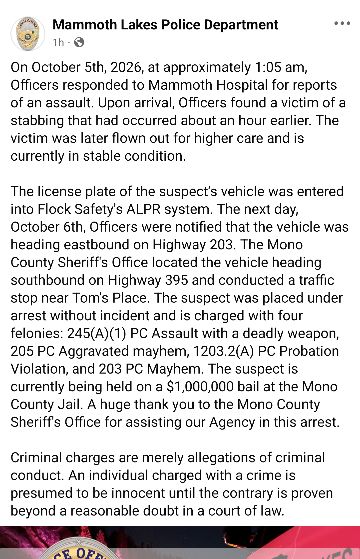
According to MLPD, officers responded to Mammoth Hospital at about 1:05 AM on October 5, 2026, for a stabbing that had happened about an hour earlier. The victim was flown out for further care and is in stable condition. Officers entered the suspect's license plate into Flock. On October 6, Flock alerted officers that the vehicle was heading eastbound on Highway 203. The Mono County Sheriff's Office located it southbound on Highway 395 and stopped it near Tom's Place. The suspect was arrested without incident on four felony charges and is held on $1,000,000 bail.

The case used a hotlist alert from a local camera and a handoff to a neighboring agency. It did not depend on statewide or nationwide sharing or on the gunshot sensors. MLPD notes that criminal charges are allegations and that the suspect is presumed innocent. No case report has been released yet, and the Town's weekly police log is posted only through August 23, 2026.

Why it matters. This is the core use presented to the Council in 2024: a plate entered after a violent crime, an alert, and an arrest the next day.

Sources (2)
37

MLPD reported other Flock successes to the Council in 2025

Added Oct. 8, 2026

At the September 3, 2025 update, MLPD described cases where Flock helped: a November 2024 hit-and-run solved from a partial plate, a shoplifting suspect found with stolen property, a stolen parking boot recovered for the ski area, an April 2025 domestic-violence suspect located and arrested after fleeing, a June 2025 dog returned to its owner after a crash, and a stolen RV from Nevada recovered with an arrest. In February 2025, the Chief reported that a missing elderly man under a Silver Alert from Riverside County was found after a Mammoth camera alerted.

MLPD told the Council it runs about 150 searches a month and uses the system “daily.” These accounts come from MLPD's own presentations. The case reports behind them are not in the records returned so far.

Why it matters. These are the local uses MLPD points to, and they can be weighed against the sharing and expansion documented elsewhere in this brief.

Sources (2)

See the records yourself

Every document cited above is posted in full, grouped by the agency that released it.

Go to the documents